

A Simple Guide to Lifting Heavy
Weight belt not required
I’m pretty sure that progressive overload is the fitness hill I will die on. It can be challenging in a group fitness setting to progress your weight due to the ever changing variables within the class. However, group fitness classes aren’t designed to be comprehensive - they’re there to offer a specific format or style of training. If you’re a group fitness lover, making sure that you take a variety of classes is key. But there’s one thing that a group class really can’t offer: a heavy strength load.

Maximal strength can’t be improved with the loads used in group fitness classes because dumbbells simply can’t offer the maximal loads most people need. Improvements to maximal strength are achieved with ~85%+ of one’s 1RM, using roughly 2-5 sets of 5 or fewer reps. If it makes you nervous, start small. Machines offer a safer alternative to move really heavy loads in a controlled pattern.
“Is it really that important? I don’t really care how much weight I can lift…”
It’s not just about how strong you are. The benefits of strength training at a therapeutic (i.e. effective) load are vast. I’ve always used the analogy that resistance training is like your savings account - you add to it on a weekly basis and it pays dividends in the long run.
Muscle is metabolically active, so having more muscle increases your resting metabolic rate (RMR). These are the calories you burn at rest, just to stay alive. As we age, our maximal strength decreases consistently (in the absence of strength training), but declines precipitously around age sixty. Secondary to this, the ability to quickly produce force declines even faster than strength losses.
To mitigate strength and force production losses into older adulthood, focusing on neural drive may help. The more weight you lift, the harder your nervous system works to ensure enough muscle fibers are recruited for the task. Neuromuscular adaptations happen at various intensities because we all eventually adapt to our training loads. Thus, progressive overload improves muscular strength via neuromuscular function. This is also why recreational sports, bodyweight exercises, and low weight / high rep movements don’t offer the same neurological benefit: the stimulus is too low.
Lastly, aging increases the risk of chronic disease, including osteoporosis, sarcopenia, heart disease, and cancer. However, increases in strength are associated with decreases in all-cause mortality, meaning the stronger you are, the less likely you are to die from one of these conditions.
Adding it to your routine
Here are some simple guidelines to incorporate a day or two of maximal strength training to your routine.
Pick a day that isn’t preceded or followed by another high intensity training day of any kind. Low-intensity or steady state work the next day is ideal. Having a rest day before your strength day is even better.
On the day that you’re lifting heavy, pick one upper body lift and/or one lower body lift to complete at this intensity. Heavy lifts are your primary, multi-joint lifts: bench press, deadlift, leg press/back squat, etc. Once you’ve completed your heavy lift, you can pick a few additional exercises to do at a lighter intensity (2-4 sets of 8-10 reps).
For each big lift, start with a warm-up set of 8-10 reps with moderate weight. I personally complete 2 of these and then move to 2 heavy sets of 4-5 reps. Take 3-4 minutes to rest in between the two heavy sets. Once you start to adapt, you can always add another set of as little as 1-2 reps and work your way up to 5.
Don’t get lost in the numbers (e.g. %RM), just dial in a weight that only allows you to complete 4-5 reps.
If you’re completing one heavy session a week, you can either: alternate upper body and lower body groups each week or do both as indicated in point 2.
You can still complete all your regular programming as long as you allow enough recovery to meet the demands of each individual training session. Here’s an example:
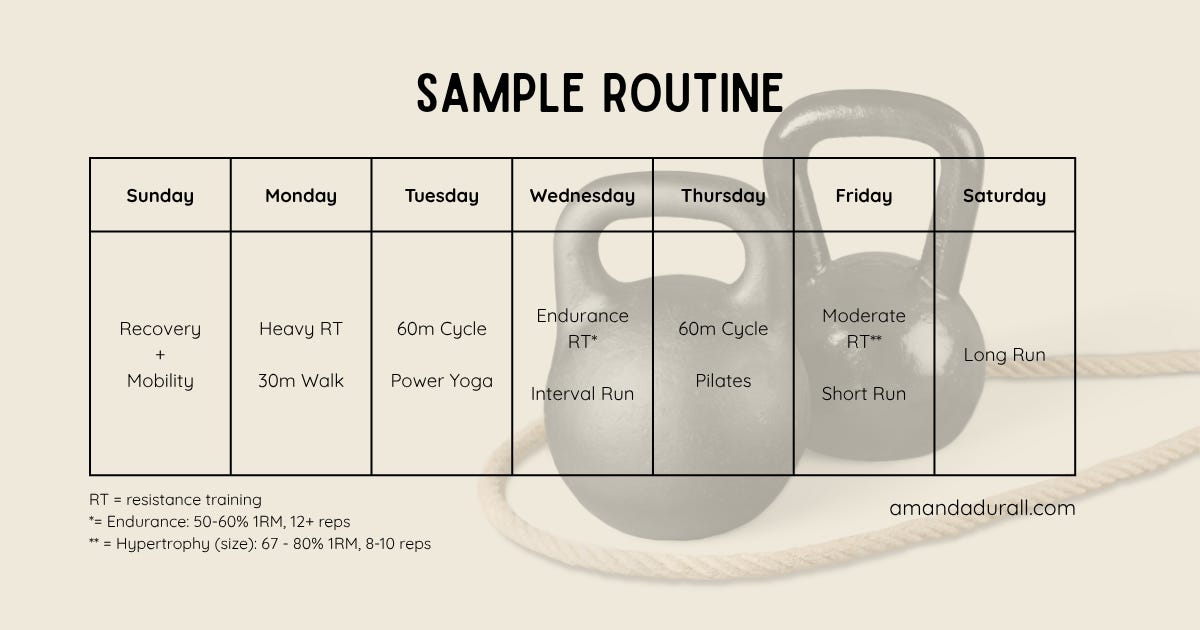
Remember to start small. One day per week for a very heavy training day is a good place to begin. It’s also recommended you modify the loads and volume throughout the week so you’re not only training muscular strength, but you’re training muscular endurance as well.
Simply Fit is a free newsletter that aims to help you simplify your fitness routine so you can make movement a regular part of your daily life. Subscribe below to receive fitness content like this. Thanks for reading!
You always explain complex topics with science backed evidence in a clear and concise way!